
The Fast Teaming Guide: Building Psychological Safety
Ever felt reluctant to ask a question for fear of looking stupid? Or not speaking out when you know what you’ve been told to do is not going to work out well? If so, you’ve experienced low psychological safety, a term used to describe the state of a team when team members don’t feel safe enough to speak up, challenge each other’s opinions, or admit mistakes, for fear of consequence. Psychological safety is highly influential, enabling good, honest and robust conversations to take place resulting in better collaborations. Teams that have it, become more creative, experimental, less conflictual and ultimately more successful.
The Positioning of Psychological Safety
In the Fast Teaming Formula™, our unique and ground-breaking Team Up team effectiveness model, building psychological safety (Get Safe) sits between building clarity and alignment (Get Set) and developing the necessary courage and skills required to convert this safety to useful, value adding collaborations (Get Strong).
This is because building swift ‘cognitive based trust’ is more important initially than building emotional based trust, especially for the more extreme teams. Imagine you are a Paramedic, working as part of an air ambulance crew, flying off to give life-saving care to a critically injured cyclist. What would matter more, knowing those sitting next to you in the Helicopter were thoughtful and empathic or that they understood the plan and their role in its execution?
The Fast Teaming Formula™
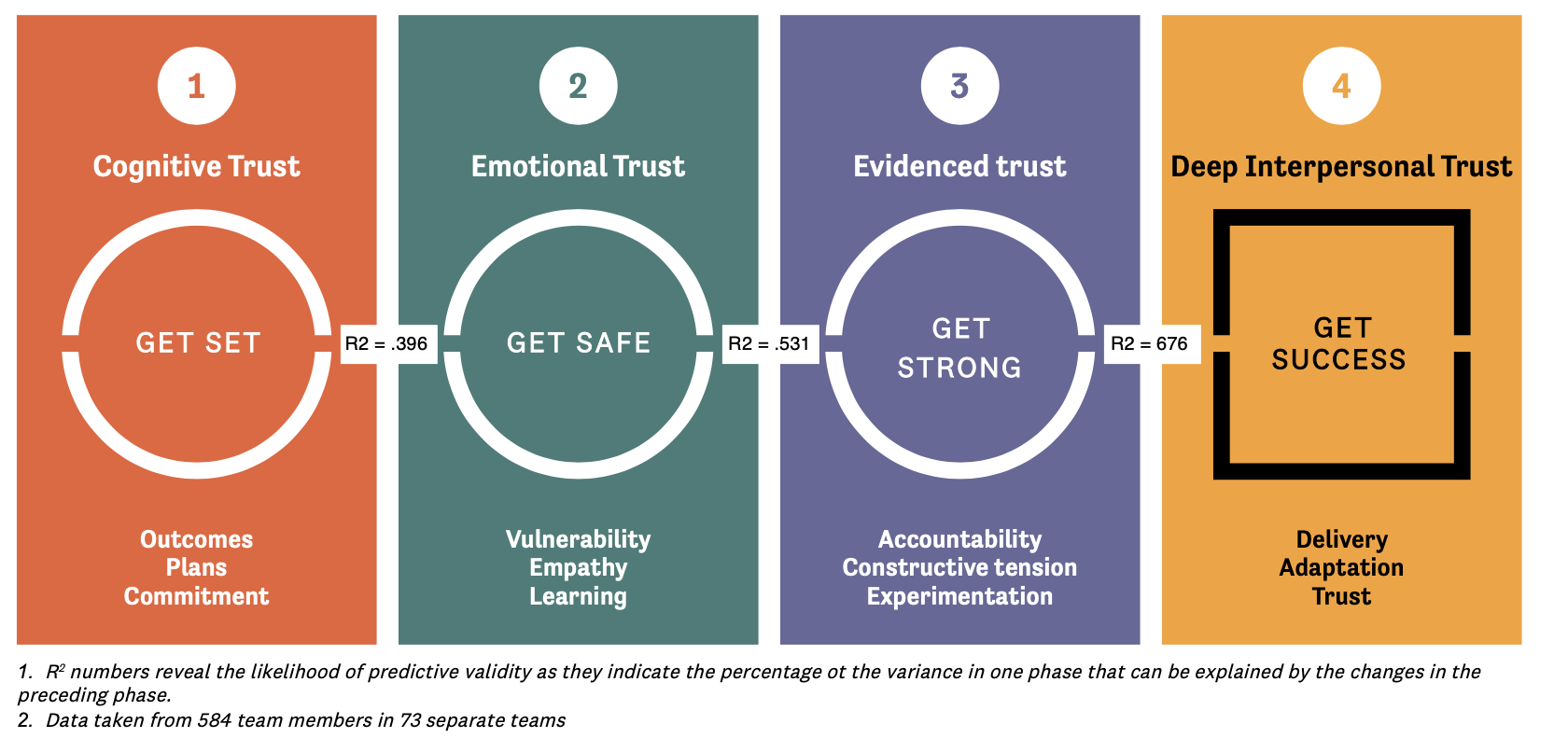
Our formula advises leaders of teams to first gain important clarity and alignment by ensuring the team agrees its purpose, set of goals, roles, agreed team behaviours and a fit for purpose governance structure, each of which we know improves team effectiveness.
Our own field studies testify what we already know from the academic literature, that teams that are ‘Set’ are then more able to accrue ‘Safety’. Most of us would agree though, that these days, clarity is increasingly a temporary state. Having to replan, re-align responsibilities and adjust how we govern yourselves has become a never ending game. We know that only the teams able to quickly ‘reset’ are the ones best able to thrive. We also know that the conversations enabling this resetting are only possible if high levels of psychological safety are also matched with high levels of assertiveness required to influence, tolerate constructive tension and take balanced risks, all three of which we find in the Get Strong phase of our formula. For all these reasons, we position with confidence Getting Safe, sandwiched between Get Set and Get Strong.
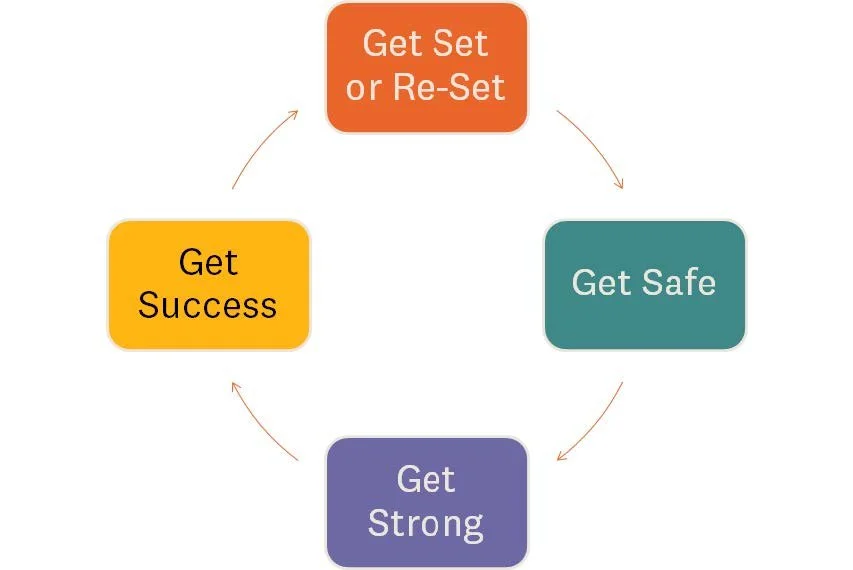
Get Set to ➡ Get Safe to ➡ Get Strong to ➡ Get Success ➡ Reset
How to Build Safety
They say: ‘what goes around comes around’ which is exactly what happens when it comes to building psychological safety. The best teams actively engage in psychological safety boosting practices and behaviours, rather than waiting to be ‘safe enough’ to engage in them.
The safest teams tend to be on the front foot, not the safest foot. At Team Up we train teams in SAFE dialogue, an acronym we use that summarises the verbal skills described below, each of which we know fuel vulnerability and empathy.
Step 1
Increase levels of Vulnerability
We display vulnerability when we are open about not being perfect. It sounds crazy but many of us are afraid of doing this by revealing ‘this is me, this is who I really am’. Thankfully we are now seeing more celebrities, such as Simone Biles, Heston Blumenthal and Freddie Flintoff, do exactly this by sharing their mental health challenges. Here are some practical ways to display vulnerability, and in doing so, create a climate for others to do the same.
Admit what you are not so good at and ask team members for help – it might be preparing a presentation, something technical or simply time management. Be prepared to admit you are not perfect.
Share your emotions – say what you feel, not just what you think. ‘I’m so pleased’ is different to ‘that was really good’.
Apologising – tough for some leaders, but humility is essential for trust. Be prepared to admit a mistake and the impact it may have had on the team.
Use humour, especially when aimed at yourself and raise energy and belief with positivity and appreciation – It lightens mood and creates bonds.
Step 2
Meet Vulnerability Half-Way with Empathy
Without empathy we risk leaving those who are vulnerable ‘hanging’ and wondering the worst. Unlike sympathy, which is passive, empathy is dynamic and visible, helping us respond sensitively to what we see and detect in others. It requires us to be self-aware, calm, and emotionally intelligent. Ways to do this are:
Listening attentively to build trust and intimacy. We hear through our own filters and naturally miss valuable detail as our minds wander, so the best way by far of showing we’ve listened, is restating what we are hearing or paraphrasing. Ironically, we risk getting this wrong and losing face, but any misses or mistakes are great as they enable misunderstandings to be fixed and received well only increases the belief that honest mistakes will go unpunished.
Asking questions with an open-mind and with a genuine curiosity to explore what’s ‘going on for the other person. We know that teams that ask lots of questions tend to perform better than those who don’t. Questions build safety.
Encourage contributions from all, avoid cliques, and ensure fairness. I’ve never worked with a team where cliques can co-exist with high levels of psychological safety.
Listen for emotions leaked by others (voice, facial expression, body language) and then reflect back what you are sensing out loud (e.g., “You’re clearly upset” or “you seem a bit unsure about this.”)
Build the Learning Team
Amy Edmondson discovered that it was through learning conversations that teams convert accrued psychological safety to something of tangible value, such as less time managing interpersonal conflict or meetings that solve problems quicker. Here’s how to do this…
Schedule regular team learning conversations.
At these, openly discuss failures and learning whilst also celebrating successes.
Acknowledge near misses and effort.
Recognise qualities shown in failed attempts as well as successes.
Ensure feedback is given descriptively. ‘I haven’t heard from you’ is descriptive. ‘You don’t care enough’ is judgemental, evaluative and blaming.
There’s a saying in couples therapy that unless couples can talk ‘about their relationship’ there really isn’t ‘much of a relationship’. Similarly, unless teams can reflect on how they are working together, they are probably not working that well together. This is what Amy Edmondson was referring to when she highlighted the role of learning conversations in converting psychological safety to ‘value’. It is what we also discovered when we analysed our own data from administrating our Fast Teaming Playbook® diagnostic to 74 different teams across multiple organisations. We found that along with asking questions, team learning conversations were the single most powerful determinant of adaptability.
Key Takeaways
Psychological safety matters – without it, teams don’t do that well.
The best teams are on the front foot, building it, rather than on the back foot, waiting for it.
Getting task related clarity and alignment in the Get Set phase of the Fast Teaming Formula™ helps to build psychological safety.
Increasing the team’s ability to be vulnerable with each other by revealing ‘imperfections’ helps in the first instance, to build psychological safety.
Empathic responses such as questioning, appropriate humour and active listening then fuel further growth.
A routine of team learning discussions, rich in vulnerability, empathy and positivity, is the key ingredient that converts any accrued psychological safety to better performance outcomes.
➜ Read George Karseras’s Ground Breaking Book: Build Better Teams for a more detailed potted history of team development and useful tips and techniques to speed up building your team from applying the Fast Teaming Formula™, the new fast working team building code, endorsed by both Amy Edmondson and Edgar Schein.