
The Fast Teaming Formula™ Explained
“A compelling and practical team building “code” to optimise team performance”
The Need For Speed
Most leaders know the fundamentals of building effective teams, but either fall short (most workplace teams are 'mediocre at best') or are too slow in implementing what they know. To compete in this digitalised world teams must be able to deliver at speed. But where do leaders go for help here? Many team effectiveness models tend to trade off simplicity for reliability. Leaders may think they are building their teams quickly and efficiently, but they are not. Many are doing the right things, but in the wrong order. What they need is some certainty. A method that stands up to scientific scrutiny, yet is also simple to use.
The Construction of the Formula
From 2016 to 2021, a team of researchers at Team Up combed through hundreds of thousands of work-related, organisational psychological studies, extracting only findings from high-impact, peer-reviewed journals. They rejected popular but less scientific sources like Forbes and Harvard Business Review in favour of research with strong content and predictive validity.
The result? The Fast Teaming Formula™ – a four-phase, 27-behaviour formula for building high-performing teams. It’s simple, measurable, comprehensive, sequential, and supported by robust data, including 2 field validations, firstly with 22 teams and 170 team members and more recently in 2025 with 73 teams and 584 team members.
The Fast Teaming Formula™
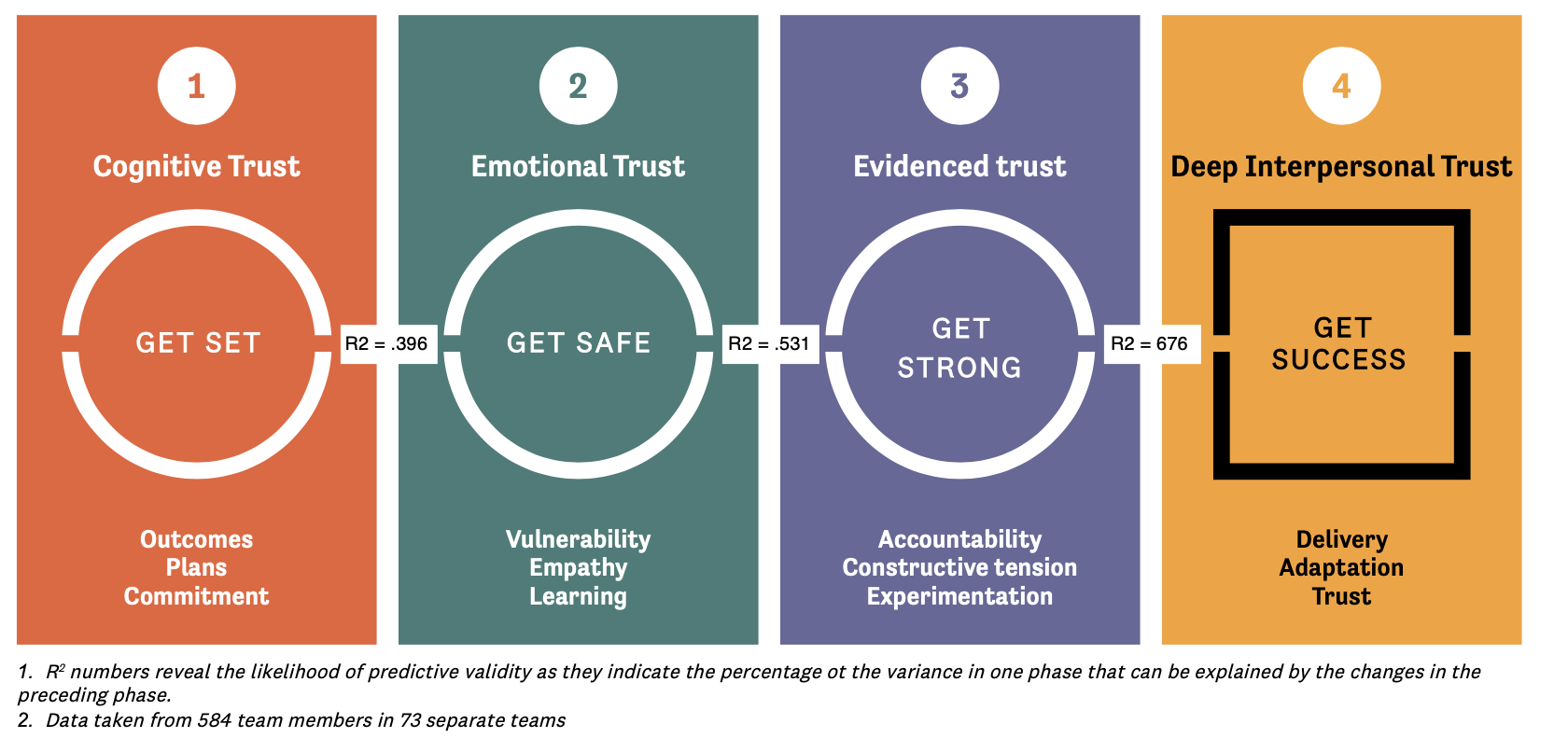
The Team Up Code consists of four sequential phases:
Get Set
Get Safe
Get Strong
Get Success
Each of the first three phases contains three sets of 3 skills. The fourth phase, Get Success, captures the performance outcomes.
Phase 1
Get Set – Establishing Swift Trust
Getting Set is about gaining clarity and ensuring everyone is aligned. This upfront clarity enables the team to quickly build cognitive-based trust — a form of trust rooted in shared understanding of the mission, plans, and commitments. It creates early momentum and is especially important in new or fast-changing environments.
Mission
Shared purpose, vision, and goals.
Plans
Strategy, stakeholder influence, and role clarity.
Commitments
Team behaviours, meeting practices, and “skin in the game” contributions to the team.
Research consistently shows that this early clarity helps teams provide better feedback, build stronger identities (particularly in global or virtual settings), and establish the foundation for psychological safety.
Phase 2
Get Safe – Building Psychological Safety
In this phase, the team develops emotional-based trust by creating an environment of psychological safety — something not emphasised in several well-known older team effectiveness models (e.g., Tuckman, Lencioni).
Vulnerability
Asking for help, showing gratitude, using humour.
Empathy
Listening well, sharing knowledge, respecting differences.
Learning
Asking humble questions, reflecting, giving feedback.
Psychological safety enables team members to take interpersonal risks, speak openly, and collaborate more effectively. According to Google’s Project Aristotle, it is the strongest predictor of team success.
Phase 3
Get Strong – Driving Performance Behaviours
Get Strong is where real value creation happens. Trust and safety now translate into high-impact behaviours such as ownership, accountability, and experimentation.
Autonomy
Working without micromanagement, committing verbally.
Constructive Tension
Giving and receiving feedback, holding others accountable.
Experimentation
Acting on incomplete data, innovating, navigating conflict.
These are often the behaviours leaders hope to see from the very beginning — but the formula emphasises that high performance can only emerge after establishing the foundational Get Set and Get Safe phases.
Phase 4
Get Success – Delivering Outcomes
This final phase reflects the tangible and intangible results of the team’s work: delivery, adaptability, innovation, resilience, and culture. It includes both hard outcomes (performance, efficiency, delivery) and soft outcomes (team enjoyment, wellbeing, learning).
The formula makes clear that it is the first three phases that consistently fuel sustainable success.
Why this Sequence Matters?
“A model that is ready to deal with the ever growing complexity that organisations will face – I much prefer this code to Tuckman’ s Forming Norming and Storming model”
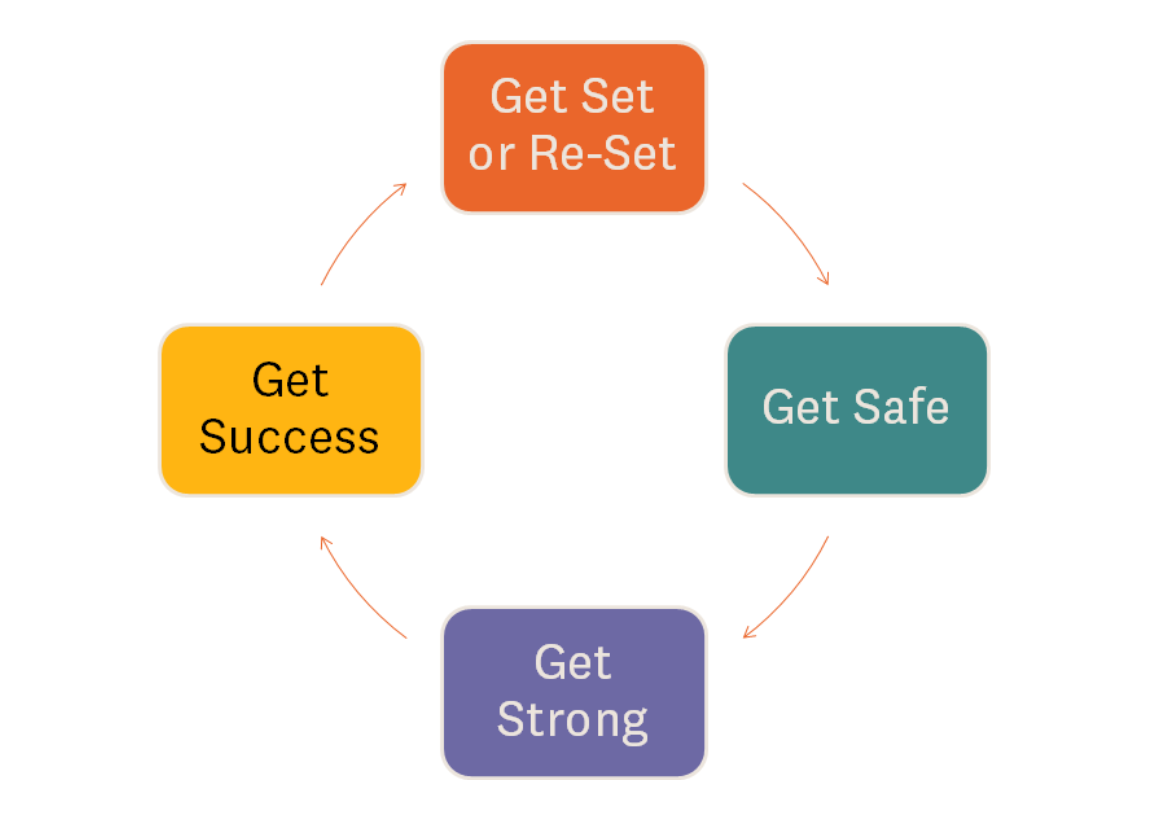
Each phase builds the foundation for the next
Regression analysis confirms that each skill set significantly predicts the next.
This means the “higher-value” team skills — ownership, influence, and experimentation — only become reliably visible when the team is strong in the Set and Safe phases.
The sequence is also circular, as today’s teams must be able to continuously reset.
Leaders are therefore advised to develop teams in this Set → Safe → Strong order.
Key Takeaways
A first-of-its-kind team development formula that is grounded in science and proven through field testing.
Start with Getting Set: Shared understandings of mission, goals, plans, and roles create the foundation.
Get Safe next: Psychological safety supports emotional trust and collaboration.
Then Get Strong: Autonomy, constructive tension, and innovation drive outcomes.
Finally, Get Success: Teams deliver results, adapt quickly to be able to reset, and thrive.
This is more than a formula; it’s the precursor to a series of practical leadership, teaming and cultural playbooks that leaders operating in any context can use with confidence.
➜ Read George Karseras’s Ground Breaking Book: Build Better Teams for a more detailed potted history of team development and useful tips and techniques to speed up building your team from applying the Fast Teaming Formula™, the new fast working team building code, endorsed by both Amy Edmondson and Edgar Schein.