
Is Now the Time for Extreme Teaming?
Extreme Teams for Extreme Times
Teams are described as ‘extreme’ when human lives are at risk, such as in the military, emergency services or deep sea mining. Although most workplace teams don’t fit this definition, it could be said that todays’ workplace teams are now working in more extreme circumstances than at any time in their history. There are 7 compelling reasons why it's high time we helped them to understand more about extreme teaming and how to do it.
In stormy seas, skippers rely on GPS, dashboards, charts and weather forecasts to guide them through their voyages. In the workplace we use dashboards, MI and data to help us navigate through turbulence. What's common to both is our use of instinct, judgement and experience to help us to make the best calls at key moments. Excellent decision making under pressure is one thing, but without coordinated delivery it's useless. We can learn a lot here from extreme teams - the way they create crucial survival and performance outcomes like cohesion, trust, efficiency and adaptability?
Leaders of extreme teams, like pilots, tend to rely on simple rules of thumb or 'playbooks' to guide them on what to do and in what order, when the pressure is most severe. These have been designed and tested to be simple to follow and practical to use, especially in the most extreme conditions. The pilot's pre-takeoff check list being one example, and the 'procedure' to take should an engine go down being another.
Challenge 1 — Complex Teaming Structures
Many workers now belong to more than one team and have to work in cross functional teams, both of which make leading tougher. Flattening structures also mean leading larger teams which are harder to galvanise, the ideal team size being between four and eight. As teams increase above 10, as we so often see, especially in more senior teams, we also witness exponentially more interpersonal friction.
Challenge 2 — Digitalisation
Techology with its accelerating rate of change, has forced us to operate with unprecedented speed and adaptability. Teams are now set, then constantly reset, in perpetual phases of transition. This disruption is unsettling, stressful and undermines team confidence and cohesion.
Challenge 3 — Regulation
The ever increasing pressure to work faster now combines with an ever increasing pressure to conform to more and more regulation. Extra bureaucracy slows us down and makes us feel like we are caught between a rock and a hard place.
Challenge 4 — Virtual Working and Hybrid
COVID-19 turbo boosted an already existing trend towards virtual-working and its adverse effect on team alignment, coordination and clarity. On-line workers experience more isolation and complain of receiving less empathy. Feedback and honest conversation become more constrained. As a result, teams suffer more interpersonal conflict and weaker team identities.
Challenge 5 — Growing Individualism
Self-orientation is growing globally. We are witnessing less of a ‘team comes first’ mentality and more of a ‘what’s in it for me’ mind-set. The actions of today’s global political leaders only serve to make it tougher for workplace leaders to build great teams.
Challenge 6 — Increasing Diversity
Thankfully, Black Lives Matter, Wokeness, and the Me Too movements have taken our collective consciousness to another level. Profoundly important and helpful as diversity is (to performance outcomes), it also makes the task of leading teams more complex.
Challenge 7 — Worsening Mental Health
Leaders now have to coach, counsel and act as therapists, as part of their job descriptions. AI and what it means for job security, only makes a growing mental health agenda even more formidable.
Meeting these Challenges
To what extent can we guide and help today’s leaders, operating in this highly demanding context? We know that the inherent complexity of teams means we are unable to offer them a guaranteed ‘Silver Bullet’. Teams are unique in identity and context, emerging systems containing multiple interacting parts and circular feedback loops. They contain annoying things called people who are unpredictable and irrational, inherently fallible, political, emotional, illogical and unpredictable entities to lead. How far can we go in helping them?
The more the better. Under pressure, good structure, and trusted routines, matter. Ideally, some kind of map or playbook with proven ‘rules of thumb’, that was well- researched, validated by field studies and endorsed by experts. Not so much a ‘silver bullet’, more a simple guide to help desperate leaders find their pathway in the eye of this storm. When I searched for this pathway, I couldn’t find one, or more accurately, one that I trusted. I felt I was searching for the Holy Grail. Unperturbed, I started looking at how extreme teams operated. If any team used rules of thumb and heuristics, it would be these. Then we looked at what team behaviours predicted others. A code or sequence started to emerge. After 5 years of researching, refining and testing, we created a world-first robust, simple team building code, made for our times, the Fast Teaming Formula™.
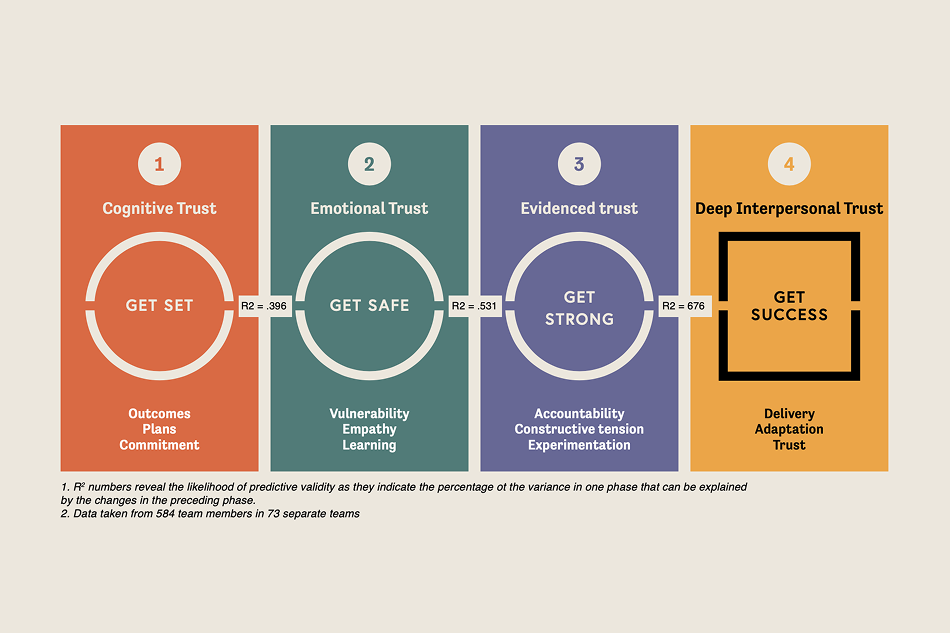
Driven to meet our ever increasing requirement of speed, this formula gives leaders the fastest way to build a team, each stage relying on the previous, to aid impact. It not only describes the modern day behaviours that make a team ‘great’, but uniquely the order in which to develop them. It lists the nine ‘agreements’ needed to quickly set the team up for success, the quickest ways to build psychological safety and lays out the stepping stones to improve in very good time, levels of autonomy, construction tension and experimentation.
Already supported by evidence based research, we then ran further field studies to prove its robustness (see the R numbers above). Most importantly of all, we’ve used it to help leaders, and their teams solve common problems like reducing friction; building virtual teams: speeding up trust building and dealing with self-serving individuals.
Read our other papers in this section to learn how the formula works – it’s really rather simple. Or for more detailed explanations, stories and case studies, buy the book. I am confident that both will help you and your team to perform better, to keep performing better, and consistent with our mission, to improve well-being in challenging times.
Key Takeaways
There are 7 reasons why teams now operate in the most extreme of times.
Leaders seeking to build great teams, desperately need more help.
Historically this help has not been that well thought through.
Despite the complexity of teams, a navigational tool exists.
The Fast Teaming Formula™ is a ground-breaking and unique tool as it is simple, practical, scientifically supported and a proven playbook for extreme times.
It guides leaders on what to do, and in what order to fast-track team effectiveness.
➜ Read George Karseras’s Ground Breaking Book: Build Better Teams for a more detailed potted history of team development and useful tips and techniques to speed up building your team from applying the Fast Teaming Formula™, the new fast working team building code, endorsed by both Amy Edmondson and Edgar Schein.